Why Do Marketers Use SMM Panels for Social Media Growth
Social media marketers manage multiple platforms, campaigns, clients, deadlines, and performance targets simultaneously.
That is why understanding why do marketers use SMM panels matters: these platforms can centralize selected promotional services, reduce repetitive work, support campaign testing, and help teams manage visibility more efficiently.
However, an SMM panel should support a broader marketing plan rather than replace original content, community management, paid advertising, or genuine customer relationships. Its value becomes clearer when we first understand what the platform actually does.
What Is an SMM Panel and How Does It Work?
An SMM panel is an online dashboard where users can browse and order social media marketing services for platforms such as Facebook, Instagram, YouTube, TikTok, X, Telegram, Spotify, and LinkedIn.
Depending on the provider, available services may include followers, likes, views, reactions, comments, shares, watch-time-related promotion, or other forms of campaign support.
The ordering process is usually straightforward. A marketer creates an account, adds funds, chooses a platform and service, enters the relevant public profile or content URL, selects a quantity, and submits the order.
The dashboard may then display the order status, delivery progress, estimated start time, refill eligibility, and support options.
For marketers who need a centralized place to coordinate several campaigns, a reliable SMM panel can reduce the need to manage separate suppliers or repeat the same ordering process across different platforms.
GrowFollows, for example, presents multiple social media services through one dashboard and emphasizes time-saving campaign management. Once the process is clear, the next question is why professional marketers and agencies include these tools in their workflows.
The Role of SMM Panels in Digital Marketing
The role of SMM panels in digital marketing is mainly operational and promotional. Marketers may use them to support early visibility, strengthen the presentation of a growing account, test campaign approaches, or manage selected engagement tasks at scale.
They are most useful when attached to a clear objective. A marketer promoting a product launch may want initial views on a video, while an agency managing a local business may focus on Page activity or campaign-specific engagement.
The service should match the platform, content format, audience, and stage of the customer journey.
SMM panels can also help marketers coordinate activity across several social networks without building a completely different workflow for every channel. This centralization becomes especially valuable for agencies, freelancers, resellers, and in-house teams handling numerous accounts.
The following table summarizes where panels may fit within a wider digital strategy.
| Marketing Need | How an SMM Panel May Help | What Still Requires Human Strategy |
|---|---|---|
| Early campaign visibility | Supports initial exposure or visible activity | Content quality, positioning, and targeting |
| Multi-platform management | Centralizes selected services in one dashboard | Platform-specific planning and reporting |
| Social proof | Strengthens visible follower or engagement signals | Trust, reviews, reputation, and customer experience |
| Time-sensitive promotion | Helps coordinate activity around launches or events | Creative production and community response |
| Agency scalability | Simplifies repeat orders and campaign tracking | Client communication and quality control |
| Campaign testing | Allows small, controlled service tests | Interpreting results and improving campaigns |
This operational role leads directly to the practical benefits marketers look for when choosing a panel.
7 Main Benefits of SMM Panels for Marketers
The benefits of SMM panels for marketers are not limited to increasing visible numbers. Their real value often comes from saving time, controlling costs, organizing campaigns, and making selected promotional tasks easier to manage.
The strongest benefits appear when the marketer has clear objectives and treats the panel as one supporting tool within a larger marketing system.
1. They Save Time on Repetitive Promotional Tasks
Social media teams regularly repeat similar tasks across posts, campaigns, and client accounts.
Searching for services separately, negotiating with different providers, checking delivery manually, and recording every order can consume time that would be better spent on strategy or creative work.
A panel places many of these activities inside one account. Marketers can select services, review prices, place orders, monitor progress, and contact support from the same dashboard.
This explains how SMM panels save marketers time, particularly when they manage several campaigns simultaneously.
The time saved can then be redirected toward content planning, audience research, creative testing, customer communication, and performance analysis.
Efficiency naturally connects to another major reason marketers use panels: cost control.
2. They Can Be Cost-Effective for Defined Campaigns
Marketers often work within strict budgets, especially when supporting startups, small businesses, creators, or local brands.
A panel may offer different service quantities and price levels, allowing the buyer to select a package that matches a specific campaign instead of committing to a large, fixed promotional expense.
This is why SMM panels can be cost-effective for marketing when used selectively. A team can test a small order, evaluate delivery and retention, and decide whether a larger campaign is justified.
Beginner-focused guidance also recommends low deposits, understandable service descriptions, visible order statuses, realistic delivery information, and test orders rather than selecting a provider solely because it advertises the lowest price. Cost-effectiveness does not mean buying the cheapest option available.
A better calculation includes service quality, audience relevance, refill terms, customer support, delivery stability, and the potential effect on the brand.
With budget control established, marketers can focus on the visible trust signals that influence new audiences.
3. They Help Build Initial Social Proof
People frequently assess a social media account before reading every post or reviewing every offer. Follower count, video views, reactions, comments, posting consistency, profile completeness, and overall activity can shape a visitor’s first impression.
SMM panels may help build social proof by strengthening selected visible metrics around a credible account or valuable piece of content.
For example, initial activity can make a new campaign appear active enough to attract attention from people who might otherwise scroll past it.
Social proof can be particularly important for:
- New business profiles
- Recently launched personal brands
- Product or service campaigns
- Online stores
- Content creators
- Event promotions
- Local business pages
However, social proof only works when the account supports it.
A polished profile with useful content, consistent branding, genuine customer responses, and relevant engagement is more convincing than an account with large numbers but little substance.
The next benefit therefore concerns visibility rather than appearance alone.
4. They Can Support Content Visibility and Engagement
Can SMM panels increase social media engagement? They may increase selected visible interactions or give content additional initial exposure, depending on the service being used.
This can be useful for a Reel, video, product announcement, live stream, campaign post, or time-sensitive launch that already has a strong message and clear audience fit.
For instance, a Facebook monetization package SMM panel may include followers, video views, Reel views, reactions, comments, or shares. However, such services cannot guarantee monetization, platform approval, loyal viewers, or sustainable revenue.
Those outcomes continue to depend on original content, policy compliance, audience quality, account history, and consistent performance. Marketers should therefore promote content that has a realistic chance of holding attention once people arrive.
Visibility can create an opportunity, but content quality determines whether that opportunity becomes meaningful engagement.
5. They Make Campaign Testing Easier
Marketing decisions improve when they are based on controlled tests rather than assumptions.
An SMM panel can allow a marketer to compare small service packages, delivery speeds, content types, or platform responses before allocating a larger budget.
A team might test engagement on two similar short-form videos, compare regional and global service options, or examine whether gradual delivery fits an account better than a faster campaign.
The objective is not to treat purchased activity as proof of genuine customer demand.
The purpose is to evaluate the provider’s operational quality and determine which promotional format best supports an existing strategy.
Useful test criteria include:
- Delivery start time
- Order completion rate
- Retention or drop behaviour
- Relevance of comments or audience profiles
- Support response time
- Refill handling
- Profile visits after promotion
- Genuine inquiries or organic interactions
The marketer should record the initial account condition, service cost, delivery period, visible changes, and relevant business results. This creates a more meaningful test than simply checking whether the number increased.
Testing becomes even more important for agencies because they must protect both client budgets and their own reputation.
6. They Help Agencies Manage Multiple Clients
Why do digital marketing agencies use SMM panels? Agencies frequently manage numerous pages, content calendars, launches, and reporting cycles simultaneously.
A centralized dashboard can make selected promotional tasks easier to organize across clients and platforms.
Some panels may also offer bulk ordering, API connectivity, saved order histories, status tracking, and reseller features.
These capabilities can reduce manual repetition and make campaign fulfillment more consistent, particularly for agencies that provide social media support as part of a broader service package.
An agency could use a panel to coordinate services for:
- Facebook business pages
- Instagram creator accounts
- YouTube channels
- TikTok campaigns
- X profiles
- Telegram communities
- Spotify artists
- LinkedIn company pages
Still, an agency must maintain clear internal controls. Every client should have defined goals, approved services, spending limits, quality standards, and reporting rules.
The panel may handle service delivery, but the agency remains responsible for strategy, transparency, account safety, and client expectations.
That responsibility makes provider selection one of the most important parts of the process.
7. They Offer Flexible Services for Different Objectives
Not every marketer needs the same type of support. A creator may want video visibility, an e-commerce brand may focus on product-post activity, a local business may prioritize credibility, and an agency may need scalable multi-platform management.
SMM panels usually offer different quantities, delivery methods, targeting options, and service categories.
This flexibility lets marketers choose support based on campaign stage instead of relying on a single package for every account.
The table below shows how different objectives can shape service selection.
| Marketing Objective | Potential Panel Support | Recommended Strategic Pairing |
|---|---|---|
| Launch a new profile | Gradual followers or Page activity | Profile optimization and introductory content |
| Promote a strong video | Views or engagement support | Better hooks, thumbnails, captions, and retention |
| Support a product launch | Reactions, views, or post activity | Paid ads, creator content, and landing-page tracking |
| Improve event visibility | Live-stream or scheduled-post support | Email reminders and community promotion |
| Manage client campaigns | Bulk orders, tracking, or API tools | Client approval and performance reporting |
| Strengthen credibility | Relevant visible activity | Reviews, customer proof, and regular publishing |
Flexibility is valuable, but it also creates the risk of choosing a service that does not match the account. A clear selection framework helps prevent that mistake.
How Social Media Marketers Should Choose an SMM Panel
Understanding how SMM panels help social media marketers is only useful when the provider is dependable.
A weak panel can create delayed orders, unstable delivery, irrelevant engagement, unclear charges, or support problems that damage campaign results.
Marketers should review the complete platform rather than focusing on one attractive price or delivery claim.
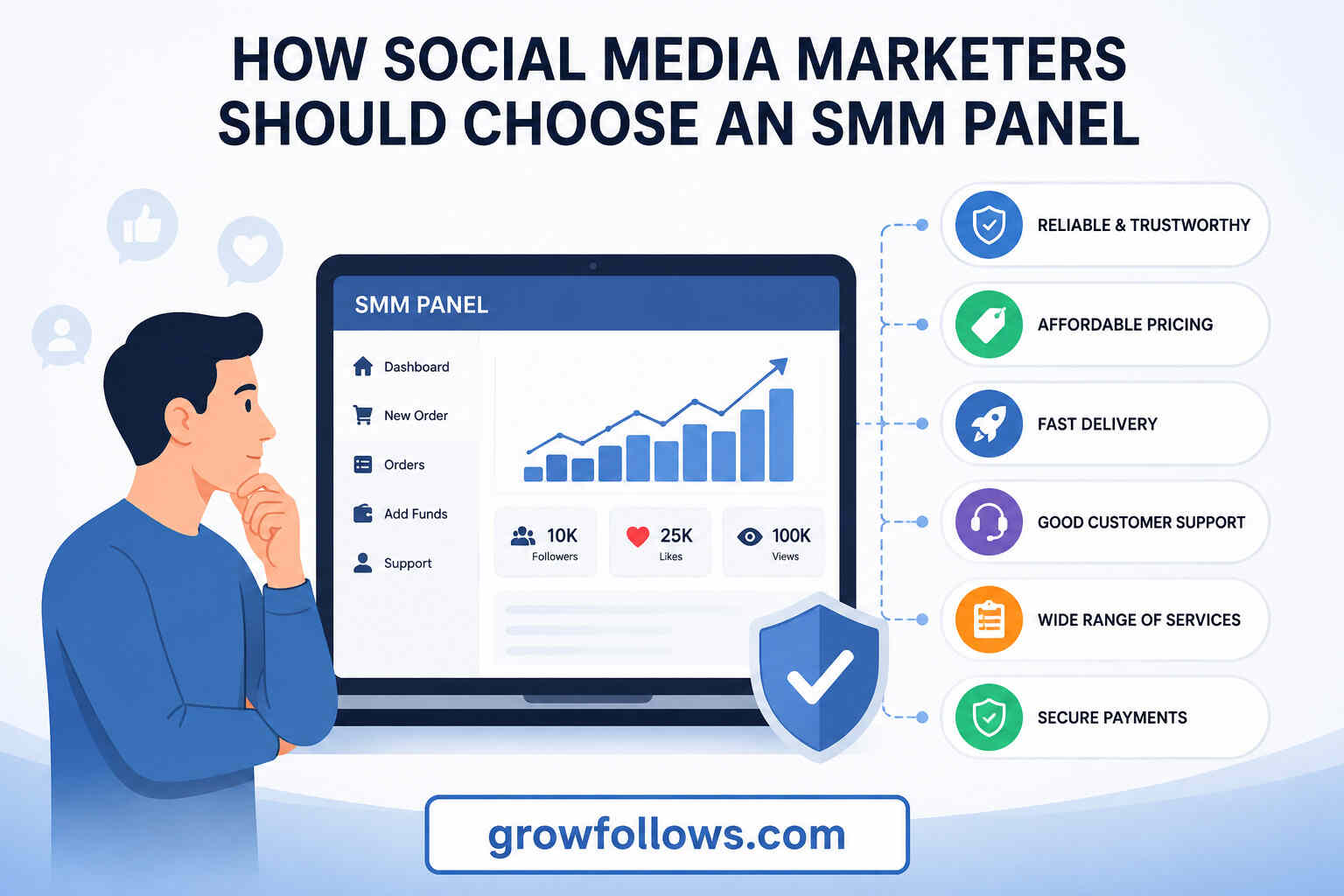
A practical guide on how to identify a high-quality SMM panel recommends checking service descriptions, secure payments, order tracking, refill policies, retention, realistic delivery, responsive support, and overall transparency.
It also advises beginning with a small controlled order before increasing spending.
Service Descriptions
The marketer should know exactly what is being ordered, how delivery works, whether the service is targeted, and what limitations apply. Vague descriptions make it difficult to compare options or set realistic client expectations.
Protect Account Information
A standard order should normally require a public profile, post, video, or channel URL. Marketers should be cautious when a provider requests a password, recovery code, authentication code, or access to private messages.
Review Order Tracking
Visible order statuses help teams manage deadlines and identify service problems. Common statuses may include pending, processing, in progress, completed, partial, or cancelled.
Examine Delivery Expectations
Extremely fast delivery may not be appropriate for every profile. A small or inactive account may require more gradual activity than an established account running a time-sensitive campaign.
Understand Refill and Refund Terms
Buyers should know when a refill applies, how long the refill period lasts, what level of drops qualifies, and what happens when an order cannot be completed.
Test Customer Support
Agencies need reliable communication when campaigns are active. Testing the support team with a simple pre-sale question can provide an early indication of response quality.
Begin With a Small Order
A small test reduces financial and reputational risk. Marketers can evaluate the delivery, retention, targeting, support, and account effect before committing a larger budget.
New users can also compare a best SMM panel for beginners based on usability, low starting deposits, support, tracking, and transparent policies rather than price alone.
How to Use an SMM Panel Without Replacing Organic Marketing

SMM panels work best when they support content people genuinely want to consume. Marketers should first optimize the profile, clarify the offer, publish useful content, and create a clear path from attention to action.
A balanced campaign may combine panel-based promotional support with organic posting, community replies, influencer partnerships, search optimization, email marketing, paid advertising, and landing-page conversion tracking.
This creates several traffic and trust sources instead of making the brand dependent on one metric.
| Campaign Stage | Marketer’s Action | Panel’s Supporting Role |
|---|---|---|
| Prepare | Optimize the profile and publish credible content | No panel service needed yet |
| Test | Identify posts with promising organic response | Place a small controlled order |
| Observe | Monitor retention, visits, comments, and inquiries | Track delivery status |
| Improve | Adjust the creative, targeting, and offer | Select only services that fit |
| Scale | Expand proven campaigns gradually | Support selected high-performing content |
| Report | Compare outcomes with campaign cost | Record order and delivery data |
The marketer should continue responding to genuine comments, publishing consistently, improving creative quality, and reviewing platform analytics.
This approach keeps the team focused on outcomes such as leads, sales, qualified traffic, watch retention, and customer trust rather than treating follower or view totals as the final objective.
How SMM Panels Fit Into the Customer Journey
A successful campaign should consider what happens after someone notices the social proof or reaches the promoted content.
Visible activity may attract attention, but the profile and offer must move the visitor toward a meaningful next step.
At the awareness stage, marketers may use promotional support to help content receive initial exposure.
During the consideration stage, educational posts, testimonials, demonstrations, and comparisons can help visitors understand the brand.
At the conversion stage, the audience needs a clear action such as visiting a website, requesting a quotation, registering for a service, purchasing a product, or contacting the business.
The panel therefore supports only a limited part of the journey.
| Customer-Journey Stage | Main Goal | Required Marketing Asset |
|---|---|---|
| Awareness | Attract attention | Strong videos, Reels, posts, or announcements |
| Consideration | Build interest and confidence | Guides, reviews, demonstrations, and proof |
| Conversion | Generate an action | Landing page, offer, CTA, or contact method |
| Retention | Maintain the relationship | Customer support, valuable content, and email |
| Advocacy | Encourage recommendations | Strong experience and genuine community |
Without these supporting assets, increased visibility may not produce measurable business growth.
This is why experienced marketers evaluate both campaign metrics and commercial outcomes.
Risks and Limitations Marketers Must Consider
An SMM panel is not a guarantee of organic reach, platform approval, monetization, revenue, or customer loyalty.
Poor-quality or artificial engagement can distort analytics, weaken audience relevance, create sudden metric spikes, or produce numbers that do not contribute to business performance.
A large follower count with minimal genuine interaction can make it difficult to understand what the real audience wants.
Irrelevant comments or followers from unsuitable locations may also weaken the credibility the marketer intended to build.
Platform rules matter as well. YouTube states that artificially increasing views, likes, comments, or other metrics through automated systems or deceptive methods is not allowed. It also warns that actions taken by a hired promoter can still affect the channel.
Meta prohibits coordinated inauthentic behavior across Facebook and Instagram assets. In addition, marketers should confirm current platform policies before ordering any service and avoid providers that promise:
- Guaranteed virality
- Guaranteed monetization
- Permanent engagement
- Completely risk-free artificial activity
- Instant organic ranking
- Guaranteed sales
- Impossible delivery speeds
Responsible use requires gradual testing, relevant services, honest client reporting, protected account information, and a continued focus on real audience value.
With the benefits and risks in view, marketers can make a more realistic decision about when a panel is appropriate.
When Does Using an SMM Panel Make Sense?
An SMM panel may make sense when a marketer has strong content, a defined audience, a specific promotional objective, and a controlled budget.
It can also be useful when the team needs centralized order management or wants to test a small supporting service before scaling a campaign.
It may be suitable when:
- The profile is complete and professionally presented
- The account already contains useful content
- The target audience is clearly defined
- The marketer understands the required service
- The campaign has a measurable objective
- The provider has transparent policies
- The team can monitor the results
- Organic marketing remains active
Using a panel makes less sense when the account has no content strategy, the audience is undefined, the profile is incomplete, or the campaign depends entirely on purchased metrics.
In those situations, the marketer should first improve the marketing foundation.
A practical decision rule is simple: use a panel only when it supports an existing strategy and when success can be measured beyond visible numbers.
The following questions address the most common concerns marketers have before making that decision.
Final Words
The clearest answer to why do marketers use SMM panels is efficiency.
Marketers may use them to save time, control campaign costs, coordinate multi-platform activity, test selected services, support visibility, and manage client work from a centralized dashboard.
The strongest results come from using an SMM panel as a limited promotional support tool-not as a substitute for content quality, organic audience development, paid media, or real customer relationships.
Marketers who choose transparent providers, test gradually, follow platform policies and measure genuine business outcomes are better positioned to turn short-term visibility into sustainable digital growth.
Frequently Asked Questions
What is an SMM panel in simple terms?
An SMM panel is an online dashboard that provides social media promotional services. Users choose a platform, select a service, enter a public content or profile link, place an order, and track its status from the dashboard.
Why do digital marketing agencies use SMM panels?
Agencies use them to centralize selected campaign tasks, manage multiple client orders, compare service options, track delivery, and reduce repetitive work. The panel supports fulfillment, while the agency remains responsible for strategy, quality control, reporting, and client communication.
How do SMM panels save marketers time?
They combine service browsing, ordering, payment, tracking, and support within one platform. This can reduce the time spent coordinating separate providers and allow marketers to focus more on content, optimization, customer communication, and campaign analysis.
Are SMM panels cost-effective for marketing?
They can be cost-effective when marketers place small, goal-based orders and evaluate total value rather than price alone. Service quality, retention, relevance, support, and campaign outcomes should all be considered before increasing the budget.
Can SMM panels increase social media engagement?
They may increase selected visible engagement metrics or provide initial exposure, depending on the service. They cannot guarantee authentic conversations, customer loyalty, organic distribution, sales, or sustainable growth.
How do SMM panels build social proof?
They may strengthen visible signals such as followers, views, reactions, or post activity. Social proof becomes more persuasive when those signals are supported by useful content, credible branding, genuine reviews, and responsive community management.
Are SMM panels safe for every social platform?
No service is automatically safe for every platform or campaign. Policies differ, and artificial or deceptive engagement may violate platform rules. Marketers should review current policies, protect account credentials, test small orders, and avoid unrealistic guarantees.