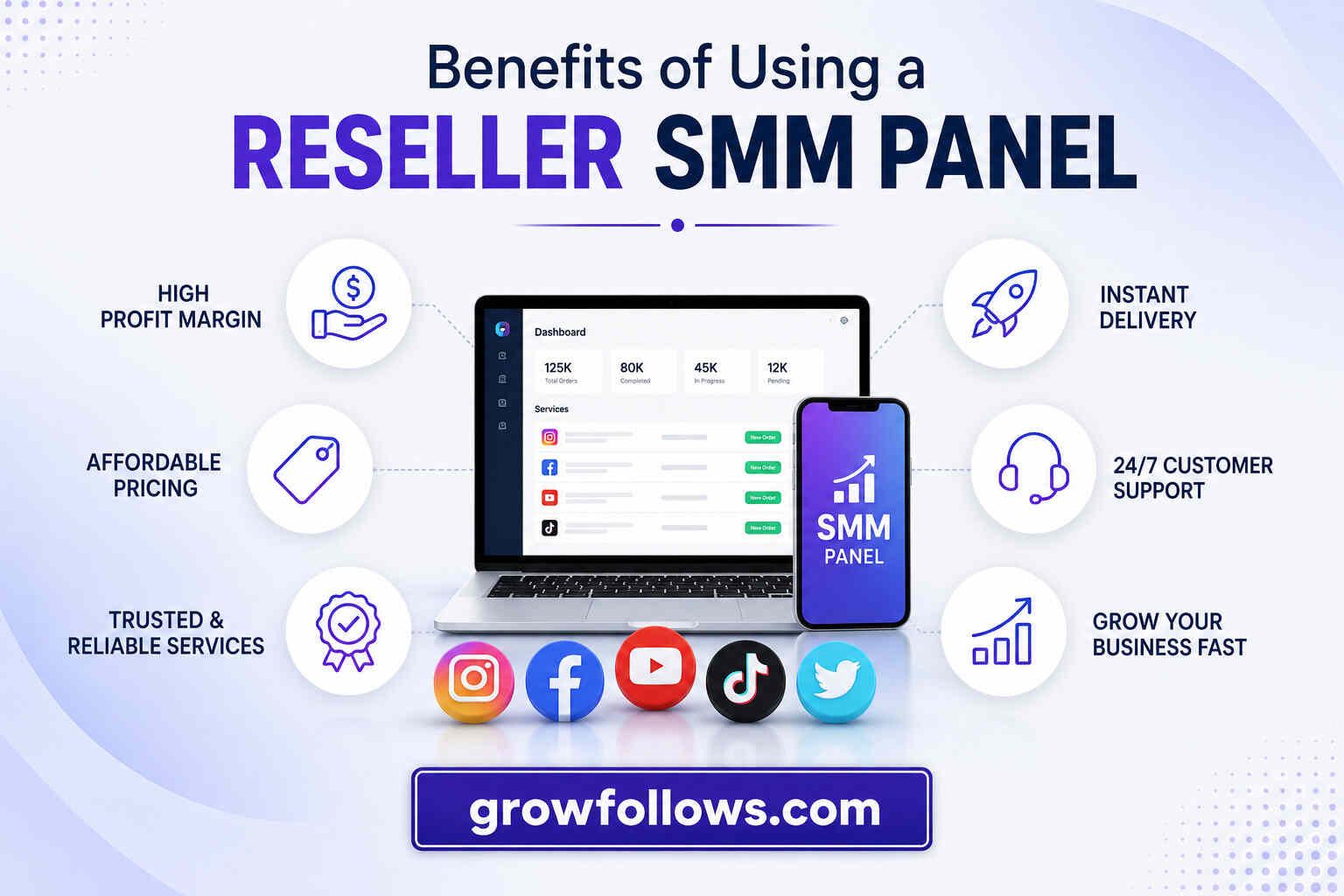
7 Benefits of Using a Reseller SMM Panel for Business
A reseller SMM panel can help agencies, freelancers, and digital entrepreneurs offer social media services without building an entire fulfillment system from scratch.
The biggest advantages are operational efficiency, flexible pricing, automation, and the ability to manage multiple client orders from one place.
This guide explains the benefits of using a reseller SMM panel, how the model works, what to check before choosing a provider, and whether it can become a sustainable business.
What Is an SMM Reseller Panel?
An SMM reseller panel is essentially a platform that allows a business to purchase eligible social media marketing services from a wholesale provider and resell those services to its own customers.
Instead of developing the technical infrastructure for every service, the reseller focuses on branding, pricing, customer acquisition, and support.
For example, a freelancer may manage social media campaigns for several clients and use a reseller system to organize service orders from one dashboard.
A marketing agency can similarly package selected services into its own client offerings.
Understanding this basic structure makes it easier to see why the model appeals to small businesses, and the next section explains how the process actually works.
How Does an SMM Reseller Panel Work?
The answer to how does an SMM reseller panel work is relatively straightforward: the reseller sits between the service provider and the end customer.
A typical workflow looks like this:
Customer → Reseller Website/Panel → Wholesale Provider → Service Fulfillment → Order Tracking
The reseller selects suitable services, establishes retail pricing, receives an order, and sends the order through the panel or an API connection.
Depending on the provider, order status, balance management, and other operational tasks can also be handled through the same system.
| Stage | What happens |
|---|---|
| Service selection | The reseller chooses services appropriate for their target customers |
| Pricing | A retail price is established based on wholesale cost and business expenses |
| Customer order | The client purchases through the reseller's preferred channel |
| Fulfillment | The upstream provider processes the order |
| Monitoring | The reseller tracks status and handles customer communication |
| Reporting | Order information can be used for client records and performance reporting |
This separation between selling and fulfillment is one of the reasons the model can be attractive. However, choosing a dependable provider remains critical because service quality ultimately affects the reseller's reputation.
7 Major Benefits of Using a Reseller SMM Panel
The SMM panel reseller benefits go beyond simply buying services at a lower rate. For the right business model, a reseller panel can reduce repetitive work, simplify operations, and make it easier to package social media services for different types of customers.
1. Lower Infrastructure and Startup Requirements
Building an independent social media service fulfillment infrastructure can require considerable technical resources.
A reseller model allows a small business to use an existing backend rather than developing everything internally.
This can be especially useful for freelancers and small agencies that want to expand their service menu without making a large technology investment.
The next benefit is closely connected to this because reducing technical workload also saves valuable time.
2. Save Time on Repetitive Order Management
Time is one of the most valuable resources for a freelancer or agency. Manually processing every individual service request can become difficult when the number of customers increases.
A centralized SMM reseller panel for agencies and freelancers can organize services, orders, balances, and statuses in one environment.
That means the business can spend more time on customer communication, campaign planning, content strategy, and acquiring new clients.
3. Flexible Pricing and Business Margins
Another important advantage is pricing flexibility. In a reseller model, the wholesale cost and the final retail price are separate business decisions.
A reseller can calculate the total cost of fulfillment, payment processing, support, marketing, and other expenses before deciding on a sustainable price. This is more useful than simply choosing the cheapest service because a low purchase price does not automatically mean a healthy profit.
For example:
| Business factor | Example consideration |
|---|---|
| Wholesale cost | Provider's service price |
| Retail price | Amount charged to the customer |
| Operating costs | Website, payment, support, marketing |
| Gross margin | Retail price minus direct fulfillment cost |
| Net profit | Gross margin after other business expenses |
This leads directly to an important question for anyone considering the model: is the business actually profitable?
4. Easier Service Expansion
A freelancer may initially provide only a few social media services. As customers request additional solutions, maintaining separate systems for every service can become inconvenient.
A reseller platform can provide access to multiple categories through a centralized interface. This allows an agency to create broader packages instead of building a completely new fulfillment process every time it adds a service.
For instance, a social media marketing package could combine content support, account management, analytics, and other legitimate marketing activities rather than relying on a single service.
5. Automation Can Improve Scalability
SMM panel automation for resellers is particularly valuable when order volume starts increasing.
Depending on the provider, API functionality can allow a reseller's website or internal system to communicate with the fulfillment platform automatically.
Instead of manually transferring every order, compatible systems can synchronize orders and status information.
Automation does not replace business strategy. A reseller still needs to test services, monitor quality, answer customers, review costs, and ensure that its marketing practices comply with the rules of the social platforms it serves.
6. White-Label Branding Opportunities
A white label SMM panel can allow a business to present its services under its own brand rather than making the supplier the center of the customer experience.
This can be useful for agencies that want a consistent brand identity across their website, invoices, service packages, and customer support. A strong brand also makes the business easier for customers to remember.
However, white-labeling should not be confused with hiding important information from customers.
Clear service descriptions, honest expectations, transparent pricing, and appropriate disclosures remain important for building long-term trust.
7. Better Workflow for Agencies and Freelancers
Agencies often manage multiple customers at the same time. Each customer may have different platforms, budgets, deadlines, and reporting requirements.
A centralized reseller workflow can make these operations easier to organize. Instead of treating every order as a separate manual task, the agency can establish repeatable processes for ordering, monitoring, reporting, and support.
That operational consistency becomes increasingly important as the agency grows, which brings us to the practical question of how someone can enter this business.
How to Start an SMM Reseller Business

If you're wondering how to start an SMM reseller business, begin with the business model rather than the technology. A panel is only infrastructure; customers and a clear offer are what create revenue.
Choose a Specific Target Audience
Trying to sell everything to everyone can make customer acquisition difficult. A better approach is to identify a specific audience.
Potential audiences can include:
- Small businesses
- Content creators
- Freelancers
- Marketing agencies
- Local businesses
- E-commerce businesses
- Personal brands
Once you understand the audience, you can choose services based on actual customer needs rather than simply listing every available option.
Evaluate the Provider Before Selling
Never assume that a large service catalog means a provider is reliable. Test selected services before offering them commercially.
Important factors include:
- Delivery consistency
- Service descriptions
- Order tracking
- Refund and refill policies
- API availability
- Customer support
- Pricing stability
- Terms and conditions
- Platform-policy compatibility
This testing stage is essential because your customer sees your brand—not the supplier—when something goes wrong.
Create a Pricing Strategy
Pricing should account for more than wholesale cost. Include payment fees, customer support, marketing expenses, website costs, refunds, and other operating expenses.
A simple formula is:
Net Profit = Customer Revenue − Fulfillment Cost − Operating Expenses
This formula gives a more realistic picture than looking only at the difference between wholesale and retail prices.
Build a Customer Acquisition System
Having a reseller panel does not automatically generate customers. You still need a marketing strategy.
SEO, content marketing, social media marketing, referrals, networking, and appropriate freelance marketplaces can all contribute to customer acquisition.
Your website should explain what each service does, who it is for, what customers can realistically expect, and any relevant limitations.
For Facebook-focused offerings, content around topics such as Facebook SMM panels can also help educate potential customers while supporting topical relevance.
Is SMM Reseller Business Profitable?
The question is SMM reseller business profitable cannot be answered with a guaranteed yes or no.
Profitability depends on several variables:
Revenue = Number of customers × Average customer spend
But revenue is not the same as profit. A business with many orders can still lose money if its acquisition costs, refunds, support expenses, and fulfillment costs are too high.
The strongest reseller businesses generally focus on:
- Reliable service selection
- Sustainable pricing
- Customer retention
- Efficient order management
- Strong customer support
- Consistent marketing
- Compliance with platform policies
A reseller should therefore treat the panel as an operational tool rather than a guaranteed income source.
How to Make Money With an SMM Reseller Panel
Understanding how to make money with an SMM reseller panel starts with understanding the customer value proposition.
The goal should not simply be to sell the cheapest service. Instead, build a clear package around a customer's legitimate marketing objective.
For example, an agency might combine social media strategy, content planning, account optimization, analytics, and selected third-party services into a monthly package.
The customer pays for a complete solution rather than having to manage several separate providers.
This approach can improve average order value while also making the business less dependent on a single service.
Can I Resell SMM Panel Services?
Yes, a business can operate as a reseller when the chosen provider permits reselling under its terms. However, can I resell SMM panel services is not simply a technical question.
You should first verify:
- Whether commercial reselling is allowed
- Whether API access is available
- Whether white-label use is permitted
- What payment methods are supported
- What happens when an order fails
- What refund policies apply
- Whether the services comply with the relevant social platform's rules
You should also avoid promising guaranteed rankings, guaranteed viral growth, or guaranteed business results. Social media performance depends on many factors outside the reseller's control.
How to Choose the Best SMM Reseller Panel
Knowing how to choose the best SMM reseller panel is arguably more important than finding the lowest price.
Use the following evaluation framework:
| Factor | What to check |
|---|---|
| Service quality | Test selected services before scaling |
| Pricing | Compare total business cost, not just headline rates |
| Reliability | Check order processing and status consistency |
| API | Confirm documentation and integration capability |
| Support | Test response quality before committing |
| Refund policy | Understand failed or incomplete order handling |
| Branding | Check white-label and custom-domain options |
| Security | Never provide unnecessary account credentials |
| Scalability | Ensure the system can handle increasing order volume |
| Compliance | Review applicable platform and provider rules |
A cheap provider with inconsistent fulfillment can cost more through refunds and lost customers. Therefore, reliability should be considered alongside price.
Reseller SMM Panel vs. Traditional Social Media Agency
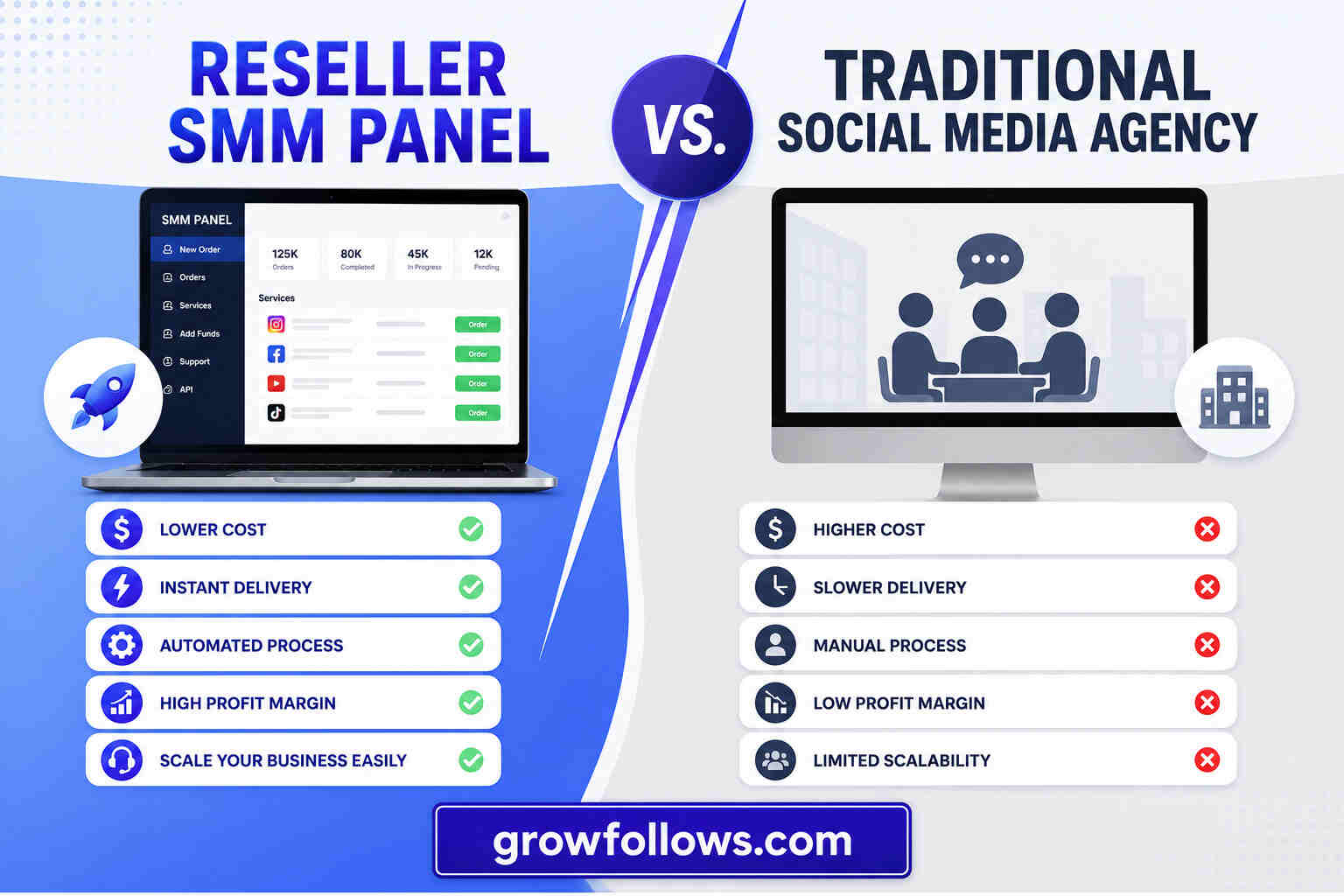
A reseller model and a traditional agency are not necessarily competitors. They can work together.
A traditional agency generally handles strategy, creative work, advertising, community management, reporting, and client relationships.
A reseller model can add a fulfillment layer for selected services.
| Reseller model | Traditional agency model |
|---|---|
| Lower technical infrastructure requirement | More services handled internally |
| Easier to standardize certain orders | Greater control over service delivery |
| Can support automation | Often more customized |
| Suitable for packaged services | Strong focus on strategy and consulting |
| Provider handles selected fulfillment | Agency handles more of the execution |
For many freelancers, a hybrid approach can make more sense: use reseller infrastructure where appropriate while keeping strategy, content, analytics, and customer relationships as the core value of the business.
Social Media Services Should Support Real Marketing Goals
A reseller panel should be viewed as one component of a broader digital marketing strategy—not a replacement for authentic audience development.
For example, a business may need better content, stronger positioning, improved creative assets, community engagement, SEO, and conversion optimization. Services sold through a reseller model should fit into that larger strategy.
On Facebook, marketers may also encounter questions about whether engagement can be purchased for individual content.
Educational resources such as Facebook likes for a single post can help explain the concept, but marketers should always consider authenticity, audience quality, and Facebook's applicable policies.
Likewise, live video campaigns require a different approach from static posts. A resource covering monthly Facebook Live stream views illustrates why different social formats require different campaign considerations.
Common Mistakes New SMM Resellers Should Avoid
The reseller model can look simple from the outside, but several mistakes can damage a new business quickly.
Choosing Only by Price
The cheapest provider is not automatically the best provider. Poor quality can lead to refunds, complaints, and lost customers.
Selling Before Testing
Always test important services before putting them into a customer package. You need to understand delivery behavior and limitations before making claims.
Ignoring Customer Support
Automation can process orders, but it cannot replace communication. Customers still need clear answers when an order is delayed or does not perform as expected.
Promising Guaranteed Results
No legitimate marketing system can guarantee that a customer will become viral, rank first, or generate a specific amount of revenue. Keep expectations realistic.
Depending on One Service
A business becomes vulnerable when most of its revenue comes from one product or platform. Diversifying your marketing offer can reduce that dependency.
The Future of SMM Reselling: Automation + Agency Services
The future of the reseller model is likely to focus less on simply listing hundreds of services and more on creating efficient, customer-focused marketing systems.
Automation can handle repetitive administrative tasks, while humans remain responsible for strategy, communication, quality control, and decision-making.
Agencies that combine these strengths can create a smoother customer experience without sacrificing personal support.
For freelancers, this can mean spending less time moving orders between systems and more time developing higher-value services.
As this shift toward automation and structured agency services continues, choosing the right reseller platform becomes increasingly important. A strong provider should not only simplify order management but also support service variety, scalability, and smoother day-to-day operations. This is where Growfollows fits naturally into the reseller model.
Why Growfollows Is a Complete Solution for SMM Resellers
For anyone exploring the benefits of using a reseller SMM panel, choosing the right provider is what turns the model into a practical business solution. Growfollows helps resellers, freelancers, and agencies manage social media services through a more organized system, making it easier to focus on customers instead of complicated fulfillment tasks.
Built Around the Needs of Resellers
GrowFollows fits the core purpose of an SMM reseller business by bringing essential service management into one convenient place. Instead of creating a separate infrastructure for every social media service, resellers can build their offers around an established system and concentrate on growing their own brand.
Key advantages include:
- Access to multiple social media service categories
- Easier management of customer orders
- Flexible options for creating profitable service packages
- A practical setup for freelancers, agencies, and resellers
- Better potential to scale as customer demand increases
| Reseller Need | How Growfollows Helps |
|---|---|
| Simple operations | Keeps service ordering more organized |
| Service variety | Supports broader customer requirements |
| Business growth | Makes expanding service offers easier |
| Scalability | Supports increasing order demands |
| Customer focus | Reduces unnecessary operational complexity |
For resellers who want a straightforward way to turn social media services into a structured business offering, Growfollows provides a practical all-in-one solution that closely matches the needs discussed throughout this guide.
Final Thoughts
The benefits of using a reseller SMM panel include lower infrastructure requirements, easier order management, pricing flexibility, automation, white-label branding, and greater scalability. But the panel itself is not the business. Sustainable results depend on choosing reliable services, understanding your customers, pricing responsibly, providing strong support, and building a broader marketing strategy.
If you approach the model as a professional service business rather than a shortcut to quick profits, a reseller panel can become a useful operational layer for freelancers, agencies, and digital entrepreneurs.
Frequently Asked Questions
What is an SMM reseller panel?
An SMM reseller panel is a platform that allows a business to purchase selected social media marketing services from a provider and resell them to its own customers. The reseller generally manages pricing, customer relationships, marketing, and support.
How does an SMM reseller panel work?
A customer places an order through the reseller's website, dashboard, or another supported channel. The reseller submits the order to the upstream provider, which handles the applicable fulfillment process. Depending on the system, APIs can automate order submission and status updates.
How can I start an SMM reseller business?
Start by identifying your target customers, researching providers, testing services, calculating your costs, setting sustainable prices, and developing a customer acquisition strategy. You can begin with a small service range and expand after validating demand.
Is an SMM reseller business profitable?
It can be profitable, but there is no guaranteed income. Profit depends on customer acquisition, pricing, fulfillment costs, operating expenses, service quality, and retention. Revenue and profit should always be calculated separately.
Can I resell SMM panel services?
You can resell services when the provider's terms allow commercial reselling. Before starting, check its reseller agreement, API conditions, branding permissions, refund policies, and any restrictions that apply to the services.
What should I look for in a reseller SMM panel?
Look at service quality, pricing, reliability, API functionality, support, refund policies, security, scalability, branding options, and compliance requirements. Do not choose a provider based only on the lowest price.
Is a white-label SMM panel useful for agencies?
Yes. A white-label system can help an agency present selected services under its own brand and create a more consistent customer experience. However, the agency should still provide transparent service descriptions and avoid misleading claims about results.